How to Find Bible Verses Mentioned in a Sermon
It is Sunday afternoon and one verse from the message is still working on you. The trouble is that all you can remember is that it was somewhere in Romans and had something to do with the mind. Knowing how to find bible verses mentioned in a sermon, whether an hour later or three weeks later, is the difference between a passage you can sit with all week and a half-memory that nags at you until it fades. This guide covers how to recover a verse you have already lost, how to catch more of them live, and how to set things up so it never comes down to memory again.
Why is it so hard to catch every verse in a sermon?
Preachers cite scripture faster than anyone can turn pages. A reference like Second Corinthians 5:17 takes two seconds to say, and while you are still finding Corinthians the next one has already gone by. A typical message has one main text and a string of supporting passages: some quoted from memory, some paraphrased, some flashed on a screen that changes before you finish reading it. Others are only partial, like "back in chapter eight" or "as Paul says later in this same letter." Nobody catches all of that with a pen.
It matters because the verses are the part of the sermon you can take home. The preacher's exact words fade within days, but the passages the message was built on are sitting in your Bible, waiting to be reread. Lose the reference and you lose the thread back into the text.
How do you find a Bible verse when you only remember part of it?
If the sermon is over and a verse is gone, you still have good options. Work through these in order:
- Search the words you remember. Put the most distinctive phrase in quotes in a search engine or a Bible search site. Searching "the renewing of your mind" turns up Romans 12:2 instantly. Even short fragments work well, because scripture is one of the most heavily indexed texts on the internet.
- Start from the main text. If you know the passage the sermon centered on, the cross-references printed beside it in a study Bible often include the very verses the preacher pulled in. Preachers and cross-reference editors tend to follow the same connections.
- Check whether the sermon was posted. Many churches upload the service to YouTube or a podcast feed within a few days. Scrub to the part of the message you remember and listen again with a pen ready.
- Ask. The pastor, or whoever runs the church's media, usually has the outline with every reference on it. Most are glad to be asked, and a little encouraged that someone wants it.
All of these work. All of them also cost time, and every one of them depends on remembering enough to search with. The verses you recover this way are the ones that struck you in the moment. The quiet ones, including the passage that might have mattered most next month, are simply gone.
How do you keep track of verses during a sermon?
For catching references live, a few habits genuinely help:
- Keep one running list of references down the margin, separate from your other notes, so everything is in one place afterward.
- Write the reference only, never the verse text. You can read the full passage later; you cannot rewind the preacher.
- Do not flip to each passage as it is named. Page-flipping is how you miss the next point, and the next reference with it.
- Jot partial references too. A margin note like "ch 8?" is enough to resolve from context that evening.
The honest limit of this method is attention. Listening for citations is not the same as listening to the message, and it splits your focus the same way taking notes during a sermon does. For a few seconds out of every minute you become a court reporter, and those are often the seconds that carried the weight.
How do you get every verse from a sermon recording?
The only approach that catches everything is to stop relying on reflexes and work from a recording. Once the audio is captured, you are no longer racing the preacher. You can replay the message and pull references at your own pace, or turn the audio into text with a sermon to text converter and read for references instead of listening for them.
A transcript changes the job completely. Every reference the preacher spoke is sitting in the text, searchable, including the partial ones, because the surrounding sentences usually make "back in chapter eight" unambiguous. Nothing depends on how fast you could write at 11:40 on a Sunday morning, and nothing depends on memory.
One step remains: getting from reference to full text. A list of citations is not the same as the passages themselves, and bouncing between a list and a separate Bible app is enough friction that most people never do it. The best setup links each detected reference straight to the verse, so you read it in context and move to the next.
Every verse caught, every verse in full
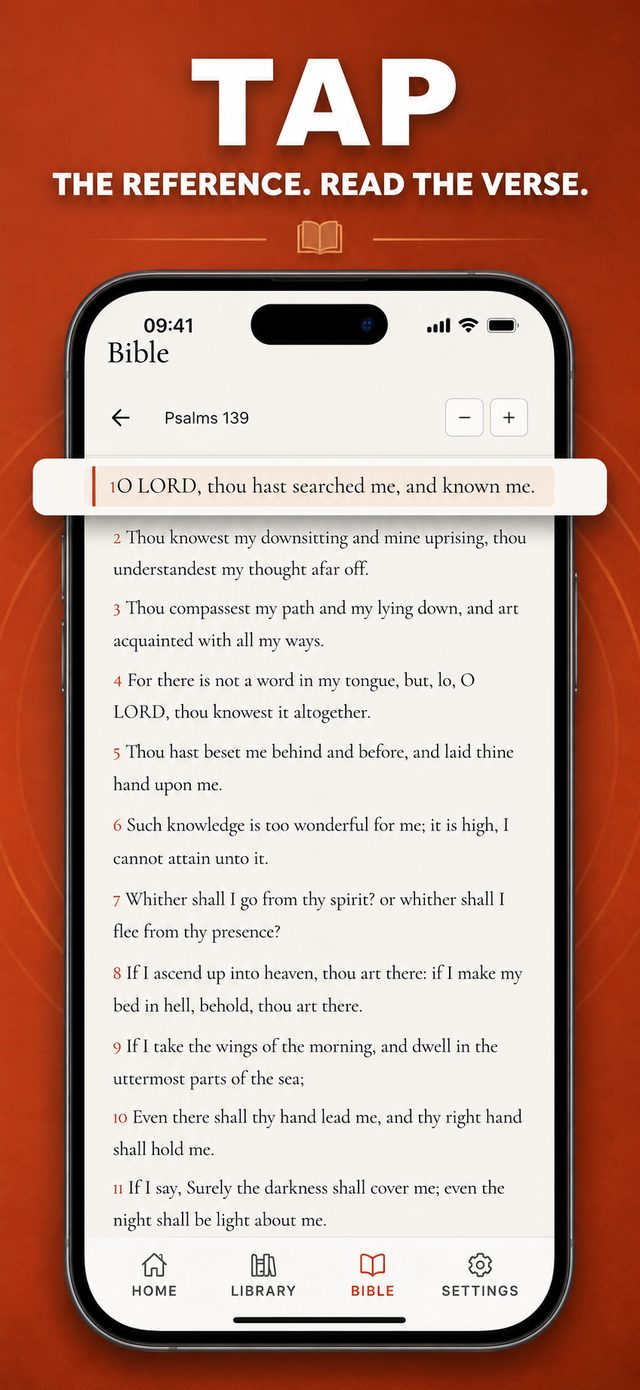
Sunday Notes AI starts catching verses while the pastor is still speaking. When a passage is named, it appears as a tappable chip on the recording screen, and one tap opens it in the built-in King James Bible without stopping the recording. After the service, the transcript pass detects every reference the preacher made, including partial ones, so nothing slips through.
Tap any detected verse to read it in full inside the app, then move to the next. Instead of a page with two references you half caught, you leave with the complete set, ready to study during the week.
Get the app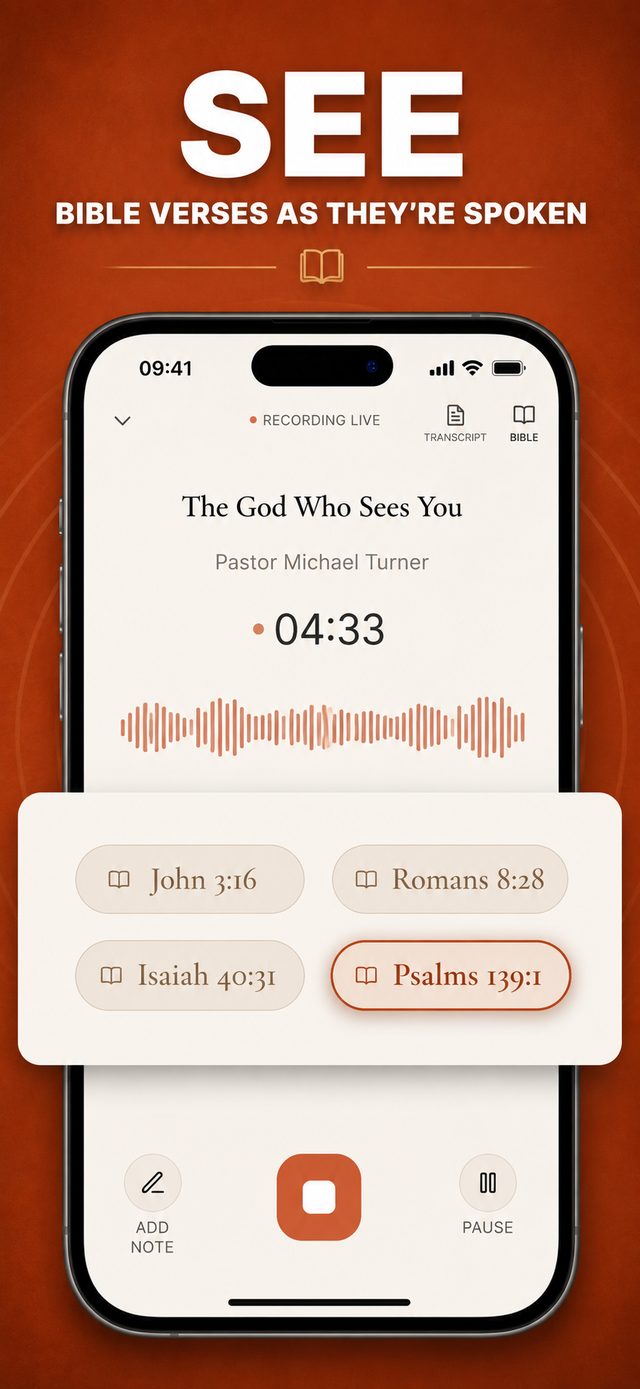
Common questions
What if the pastor only says a partial reference?
Partial references like "chapter 3 verse 16" are common, and they are recoverable from context if you have the full message captured. Working from a transcript, the surrounding words usually make the intended passage clear: the preacher has already named the book, or quotes enough of the verse to identify it.
Can I get the full text of each verse, not just the reference?
Yes, if your tool links references to a Bible. Catching the reference is only half the job. Reading the verse in full, ideally without leaving the app, is what lets you actually study the passage instead of filing away a citation you will never look up.
Which Bible translation is used?
Sunday Notes AI looks up detected references in a built-in King James Version, so every verse a pastor mentions is shown in full KJV text right next to the message it came from.
Keep reading
Catching the verses is half of holding on to a message; the other half is reviewing it, and our guide on how to remember a sermon covers that side. Or head back to the Sunday Notes AI home page to see how the whole app fits together.