The Digital Sermon Journal
A digital sermon journal is a running record of the messages you have heard, kept somewhere you can search and revisit whenever you need it. Done well, it becomes a spiritual archive: years of Sundays you can look back through, tracing what God has been teaching you over time. Done badly, it becomes one more notebook abandoned by February. This guide covers what a sermon journal is for, what belongs in each entry, whether digital really beats paper, and how to keep one going without it turning into a chore.
What is a sermon journal for?
Two things: the long view and the hard week.
The long view first. Most of a sermon fades within days, not because you did not care but because that is how memory works. A journal is the correction. Kept over months and years, it starts to show patterns you could never hold in your head: the theme that has surfaced four times this year, the verse that keeps finding you, the way your understanding of a passage has shifted since the last time someone preached it. That slow record of growth is the real reward, and it only exists if the entries do.
Then the hard week. A journal you can search means every past message is on hand when you actually need one: a friend asks the question you remember a pastor answering, a season of grief sends you back to a series on suffering, the small group you lead lands on a passage you have heard preached three times. Without a record, those messages are simply gone.
What should you write in a sermon journal?
Each entry needs two layers: the record and your response. The record is the objective part: date, speaker, the main text, the verses the message was built on, and a short summary of the argument. The response is the part only you can write, and it does not need to be long. Three honest questions cover it:
- What struck me? One line, in your own words, not the pastor's.
- What does this ask of me this week? Small and concrete beats grand and vague.
- What do I want to pray about because of it?
One true sentence per question makes a better journal than a page of dutiful summary. The record keeps the message; the response is what makes the journal yours.
Is a digital sermon journal better than paper?
For the archive, yes, and it is not close. A digital journal is searchable, which is the whole point of keeping years of entries: you can find the sermon about forgiveness from two winters ago in seconds instead of flipping through a shelf of notebooks. It is always in your pocket, it cannot be left on a pew, and it can hold the full text of a message rather than the fragments you managed to write by hand.
Paper keeps one real advantage: writing by hand slows you down, and some people reflect better with a pen. There is no rule against both. Scribble on paper during the service if it helps you listen (there is a whole guide on how to take notes during a sermon), and let the digital journal be the permanent, searchable record underneath it.
Will a digital sermon journal stay private?
This question matters more for a journal than for almost any other kind of app, because the honest entries are the valuable ones, and nobody writes honestly into something that feels public. What you admitted you are struggling with, what you prayed about in March: that is not material you want sitting in a company's cloud account.
So before you commit to a journaling tool, find out where it actually keeps your words. The best answer is on your own device, where the entries belong to you the way a paper notebook does. Sunday Notes AI is built that way: sermons, transcripts, and your notes are stored on your phone, not in an account on someone else's server.
How do you keep a sermon journal going?
Journals die from effort. If every entry starts as a blank page you have to fill after a long service, you will skip a week, then a month, then quietly stop. Two habits keep it alive.
First, shrink the writing. If the date, verses, summary, and transcript are captured for you, your part is three sentences of reflection instead of a transcription job, and three sentences is a bar you can clear every single week. Second, give it a fixed slot: Sunday afternoon, ten minutes, same time every week. Rereading the summary while you write does double duty, since coming back to a message within a day is one of the most reliable ways to make it stick.
A sermon journal that fills itself in
Sunday Notes AI works as a digital sermon journal that does the heavy lifting. Every message you record or import becomes a dated entry with its transcript, detected verses, and an AI summary, all saved to your device. You can add your own notes and reflections on top.
Over time the entries stack into a searchable archive of your spiritual life, private to you and always in your pocket. Keeping a sermon journal stops being a discipline you fall behind on and becomes something that happens every time you press record.
Get the app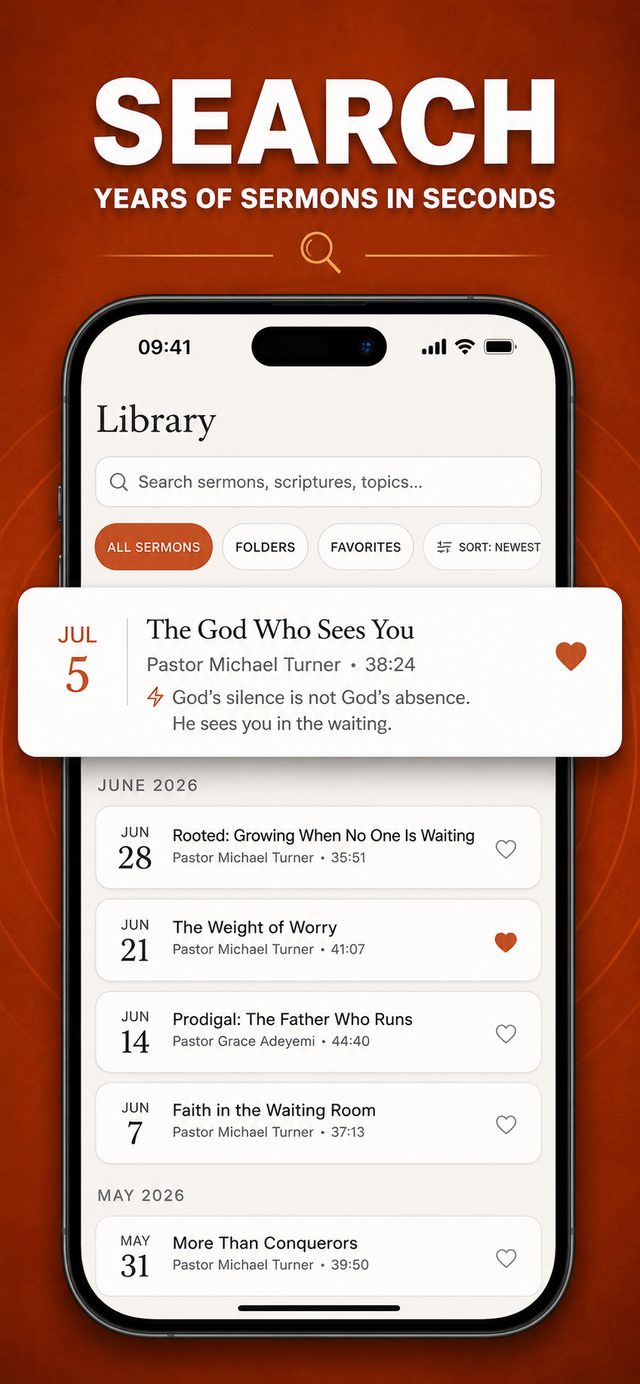
Common questions
What should I write in a sermon journal?
Beyond the date, speaker, and main verses, capture a short summary and your own response: what struck you, what you want to do, what to pray over. The mix of record and reflection is what makes it yours.
Is a digital journal better than a paper one?
Paper is lovely but cannot be searched and is easy to leave behind. A digital journal is searchable, always in your pocket, and can hold the full text of a message rather than the fragments you could write by hand.
Will my journal stay private?
It should. A journal is personal, so favor a tool that keeps entries on your own device rather than in a company cloud. Sunday Notes AI stores your sermons and reflections locally on your phone.
How far back can a sermon journal go?
As far back as you keep it. The value of a journal grows over years, because the long view reveals themes and verses that keep returning to you. A digital journal holds that history without the bulk of a stack of paper notebooks, and keeps every entry searchable.
Keep reading
More guides that go with this one: how to organize sermon notes, how to remember a sermon, sermon summary generator. Or head back to the Sunday Notes AI home page to see how the whole app fits together.